Foundation Underpinning Services: A Structural Guide to Property Stability
Soil shrinkage and swelling cause 52% of all foundation cracks every year. In the San Francisco Bay Area, where complex clay and seismic activity are daily realities, these shifts aren't just cosmetic issues. They are direct threats to the bones of your home. You likely worry that a hairline fracture today could lead to a catastrophic structural failure tomorrow. It's often confusing to navigate different foundation underpinning services when your property's market value and safety are on the line.
We believe a home is only as reliable as the ground it stands on. This guide will help you master the technical and practical aspects of structural stabilization to secure your property’s integrity for the long term. You'll learn how to achieve a level foundation that meets the 2025 California Building Standards Code effective in 2026. We will preview modern reinforcement techniques, explain the impact of local soil conditions, and provide a clear path toward total seismic peace of mind.
Key Takeaways
- Understand how foundation underpinning services stabilize your home by anchoring it into deeper, more reliable soil layers.
- Identify the specific structural red flags, like stair-step masonry cracks and sticking windows, that indicate your property needs professional attention.
- Compare the technical differences between concrete, beam, and piled methods to find the right fit for your building's weight and soil type.
- Learn the step-by-step sequence of a professional structural project to ensure your home meets the latest 2025 California Building Standards.
- Discover how foundational stabilization protects your property's market value and provides a solid base for future additions or renovations.
Understanding Foundation Underpinning Services
Foundation underpinning is a precise engineering solution designed to strengthen a building's existing footprint. For those seeking a deeper Understanding Foundation Underpinning, it's the process of extending the foundation until it rests on a more stable soil layer or reaches a specific depth. This isn't a cosmetic fix. It's a fundamental change to how your home interacts with the earth. By reinforcing the base, we ensure the structure can withstand the pressures of its environment.
In the San Francisco Bay Area, homeowners often face unique challenges. The local soil, rich in expansive clay, frequently shifts with moisture changes. Surface-level repairs like crack injections or shallow patches don't address this movement. They're temporary. High-quality foundation underpinning services solve the problem at the source. We distinguish between remedial work, which repairs existing settlement, and proactive work. Proactive underpinning is essential when you plan to add weight to the structure, such as when building a Residential Addition or converting a garage into an ADU.
The Mechanics of Structural Stabilization
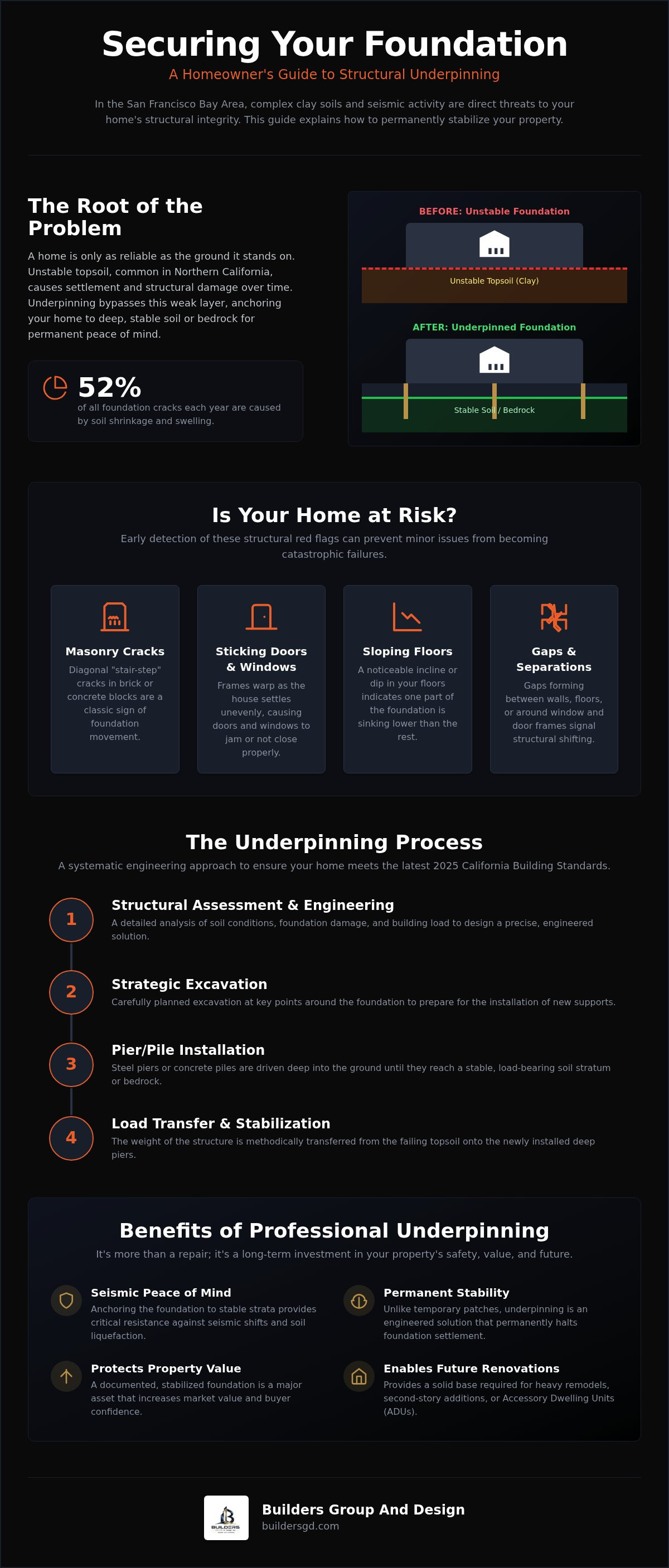
The core of this process is load transfer. We essentially install new "legs" for your home. These new support elements, often steel piers or concrete piles, bypass the unstable topsoil. They reach down to the bearing stratum, which is a deep layer of soil or rock capable of supporting the structure's weight without shifting. It's a methodical approach to stability.
This method effectively halts soil subsidence. When moisture cycles cause the upper soil to shrink or swell, your home remains stationary because it's anchored much deeper. It provides a level of vertical support that shallow footings simply cannot match in volatile environments. We focus on the "bones" of the building to ensure everything above remains level and secure.
Why Underpinning is the Gold Standard for Foundation Repair
Many property owners initially consider cosmetic crack sealing. While cheaper, it's often a waste of resources if the foundation is still moving. Underpinning is the gold standard because it provides a permanent, engineered result. It transforms a vulnerable asset into a stable one. You aren't just hiding a problem; you're fixing the mechanics of the building.
Investing in professional foundation underpinning services also preserves your property's market value. A home with a documented, stabilized foundation is a safer bet for future buyers. It offers peace of mind that the structural integrity is secure, regardless of what the Bay Area soil does next. This stability is the necessary first step before any high-end kitchen remodeling or structural framing work begins.
When to Prioritize Underpinning for Your Property
Your home communicates its distress through physical shifts. Recognizing these signs early prevents a minor settlement issue from becoming a total structural failure. While every house experiences some natural movement, specific red flags indicate that the soil beneath can no longer support the weight above. Ignoring these signals often leads to more complex and expensive repairs down the line.
Look closely at your masonry and drywall. Diagonal stair-step cracks in brickwork or interior plaster are hallmarks of foundation movement. If a crack is wider than 1/4 inch, it has moved beyond the "settling" phase and requires a professional assessment. Inside the home, you might notice doors that suddenly stick or floors that seem to slope toward one corner. Gaps appearing between window frames and the wall are another clear sign that the building's "bones" are shifting. Professional foundation stabilization ensures your home stays level and secure before these issues escalate.
In the San Francisco Bay Area, geology is often the primary trigger for structural intervention. High-clay content in the soil expands when wet and shrinks when dry, creating a relentless cycle of pressure on your footings. In certain zones, soil liquefaction during seismic activity can cause the ground to lose its strength entirely. Additionally, a "change of use" often mandates foundation underpinning services. If you are planning a Residential Addition or a heavy kitchen remodel, your existing foundation may lack the load capacity to support the new weight safely.
Seismic Considerations in Northern California
Northern California requires a higher standard of structural integrity than most regions. A "floating" foundation, which merely sits on the topsoil, is highly vulnerable during a tremor. Underpinning anchors the building to deeper, stable strata, preventing the structure from shifting off its base. This is a critical component of any residential earthquake retrofit guide for homes in high-risk zones like San Francisco or Palo Alto. It turns a vulnerable property into a resilient asset.
Assessing Foundation Cracks and Settlement
Not all cracks are equal, and it helps to understand a hierarchy of foundation cracks to triage your concerns. Natural settlement is a slow, vertical compression of soil, but subsidence is a more dangerous downward shift that requires intervention. Different Core Underpinning Methods address these varying levels of severity. A crack shifts from cosmetic to structural the moment it compromises the building's ability to distribute its own weight. At that point, foundation underpinning services are no longer optional; they are the only way to preserve the property's long-term value.
Core Underpinning Methods: Choosing the Right Solution
Choosing the right solution starts with data. You can't guess what's happening ten feet underground. Every project must begin with an engineering soil report. This document tells us the soil density, moisture content, and exactly where the stable bearing stratum begins. As a straight shooter, we recommend the method that provides the best structural outcome for your specific site. The most expensive option isn't always the right one. Our goal is to match the technical solution to the weight of your building and the reality of your terrain.
Modern foundation underpinning services utilize three primary methods to restore structural integrity. Professional The Underpinning Process requires a deep understanding of these engineering principles to ensure the structure remains stable during and after the work. We focus on long-term security over quick fixes. We look at the bones of the building first.
Helical Piles vs. Push Piers
Steel piers are the backbone of modern stabilization. Helical piles look like giant screws. We rotate them into the ground using hydraulic machinery. They're ideal for lighter structures or areas with high water tables because the screw-like "flights" provide immediate load-bearing capacity. Push piers are different. We use the actual weight of the building to hydraulically drive steel tubes deep into the earth. These are better for heavy residential homes or Commercial Additions. Both steel methods offer a major advantage; they produce very little noise and vibration. This is crucial in dense Bay Area neighborhoods where neighborly peace is a priority.
Traditional Mass Pour and Concrete Pit Underpinning
Some situations call for a more traditional approach. Mass pour underpinning involves excavating sections beneath the existing wall and filling them with high-strength concrete. It's a reliable choice for shallow foundation issues or when you're planning a basement conversion. It creates a continuous new footing that extends the reach of your original foundation. However, concrete pits have limits. If the soil failure is deep-seated, concrete pits become impractical and expensive compared to steel. We use this method where the bones of the building only need a modest extension to reach stable ground. It's about precision and choosing the right tool for the job.
The Underpinning Process: What Homeowners Should Expect
Structural work can feel overwhelming, but a well-managed project follows a predictable, methodical sequence. We operate on a "measure twice, cut once" philosophy. This means we spend significant time in the planning phase to ensure the physical labor is efficient and precise. You should expect a project that respects your property and minimizes disruption to your daily life. Professional foundation underpinning services are not just about the steel in the ground; they're about the coordination of engineering, permitting, and craftsmanship.
Phase 1: Engineering, Permitting, and Site Prep
No dirt moves until the math is verified. This phase involves structural calculations and soil boring tests to determine the exact depth required for stability. We handle the complexities of navigating local building departments in cities like Walnut Creek or San Jose to secure the necessary structural permits. Once approved, we implement site protection measures. We use heavy-duty barriers and plywood paths to safeguard your landscaping and existing interiors from construction traffic. Preparation is the key to a clean job site.
Phase 2: Excavation and Pier Installation
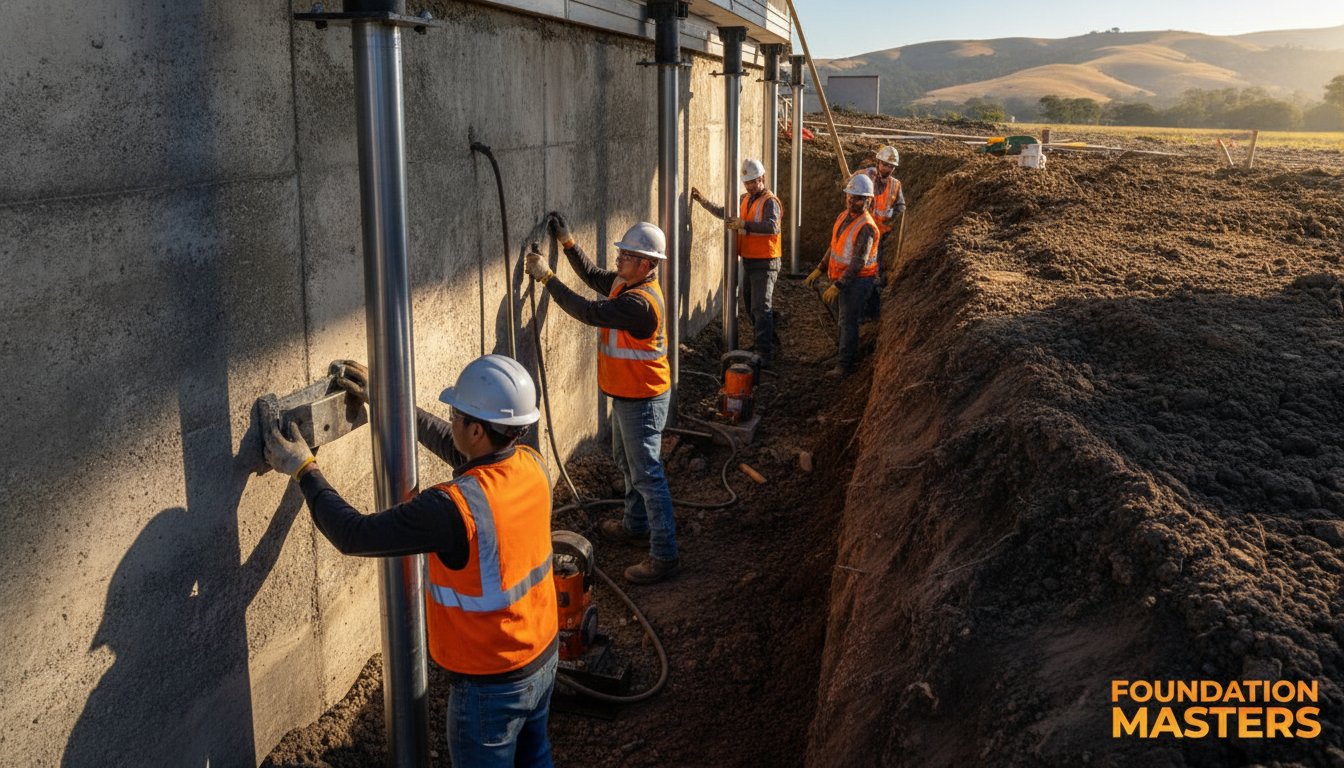
This is where the physical stabilization begins. We carefully expose the existing footing at specific intervals. Our team then drives or screws the piers to the depth specified by the engineer. A critical step during this phase is load testing. Each pier is tested with hydraulic pressure to ensure it meets the required structural capacity before it's ever attached to your home. We use synchronized hydraulic jacks to manage the weight of the structure, ensuring the load is distributed evenly across all new support points.
Phase 3: Stabilization, Lifting, and Final Grouting
If your home has settled significantly, we begin the delicate process of lifting it back to level. This is done slowly to prevent secondary damage to the upper structure. Once the target elevation is reached, we permanently attach each pier to the foundation using heavy-duty steel brackets. The final steps include backfilling the excavation sites and restoring the area to its pre-construction condition. We leave the site clean and the building's "bones" stronger than ever. If you're ready to secure your property, contact us for expert foundation stabilization services.
Structural Integrity with Builders Group And Design
At Builders Group And Design, we believe every successful project starts with a deep understanding of the building's bones. We specialize in the structural integrity required to support your biggest investments. Our team provides professional foundation underpinning services across the San Francisco Bay Area, from the hills of Lafayette to the coastal soil of San Mateo. We don't just offer repairs. We provide a stable platform for your home's future. Our goal is to give you total peace of mind through earned craftsmanship and engineering precision.
Integrating Stability with Your Remodeling Goals
Foundation stabilization is often the silent partner in high-end remodeling. If you're researching ADU builders San Jose, you'll find that structural compliance is the first hurdle. Adding an accessory dwelling unit or a 2nd floor addition places new, significant loads on your existing footprint. Without reinforcing the base, these additions can lead to settlement and structural distress. We integrate foundation underpinning services into the planning phase to ensure your new square footage is as safe as it is beautiful.
Our expertise extends well below the surface. We often perform crawl space structural repair in tandem with underpinning to address moisture issues and wood rot. This holistic approach ensures that every component of your home's support system works together. We don't believe in piecemeal fixes. We build for longevity and structural resilience.
The Master Craftsman Advantage
We approach every job site as master craftsmen. This means we value transparency and clear expectations above all else. Our reputation is built on being straight shooters who tell you exactly what your property needs to remain stable. We take pride in the physical reality of our work. Whether we're installing push piers or reinforcing load-bearing walls, we follow a steady, methodical rhythm that ensures quality at every step.
Structural pride is at the heart of our business. We invite you to consult with us on projects ranging from simple stabilization to complex residential expansions. We'll help you navigate the technical requirements of Bay Area soil with confidence and poise. Your home deserves a foundation that matches your vision for its value. Schedule a structural consultation with Builders Group And Design today to begin your journey toward lasting property stability.
Building on a Stable Foundation
Your home is likely your most significant asset. Protecting it requires a proactive approach to structural health. We've explored how identifying red flags early can prevent minor settlement from becoming a major structural crisis. Whether you're planning a residential addition or simply need to anchor your home against the Bay Area's volatile soil, making the right engineering choice is essential for long-term security.
Investing in professional foundation underpinning services provides the structural "bones" needed for high-stakes projects like ADUs or second-story expansions. Our team specializes in Bay Area structural stabilization and seismic retrofitting. We provide a comprehensive service that takes you from the initial engineering report to the final site restoration. We handle everything from foundation stabilization to load-bearing reinforcements with the precision of a master craftsman.
Don't leave your property's stability to chance. A level, secure home offers peace of mind and preserves your market value for decades to come. Secure your home’s foundation with Builders Group And Design. We look forward to helping you build a more resilient future for your property.
Frequently Asked Questions
How much does foundation underpinning typically cost?
Total costs depend on the linear footage and the specific depth required to reach stable soil. Since every property in the Bay Area has unique geological challenges, a structural engineer must first provide a detailed report. This assessment determines the number of piers and the complexity of the excavation. While it's a significant investment, it protects your home's total market value and long-term safety.
How long does a standard underpinning project take to complete?
A typical residential project usually spans two to four weeks. This timeline covers site preparation, the physical installation of piers, and the final site restoration. Factors like soil density and the total number of support points will influence the duration. We follow a methodical rhythm to ensure the work is done correctly without rushing the stabilization process or compromising on quality.
Can I live in my home during the underpinning process?
You can usually remain in your home throughout the process. Most foundation underpinning services take place on the exterior of the structure. While you will hear some noise from hydraulic machinery, the disruption to your daily routine is minimal. We use site protection measures to safeguard your landscaping and keep the work area organized and safe for your family.
Will underpinning fix the existing cracks in my walls?
Underpinning stops the movement that causes cracks, but it doesn't always erase existing damage. While the lifting process can sometimes close gaps, you should plan for cosmetic repairs like drywall patching and painting after the house is stabilized. It's essential to wait until the structure is fully anchored before fixing the skin of the building to ensure the cracks don't return.
Is underpinning covered by my standard homeowners insurance?
Standard homeowners insurance rarely covers foundation repair caused by settlement or soil expansion. Most policies exclude earth movement unless it's triggered by a specific covered event like a major plumbing failure. You should review your policy or speak with your agent to understand your specific coverage limits. We focus on providing a permanent structural solution regardless of the insurance outcome.
What is the difference between underpinning and mudjacking?
Mudjacking is a surface fix, while foundation underpinning services provide a deep structural anchor. Mudjacking involves pumping a concrete slurry under a slab to lift it. It relies on the same soil that failed in the first place. Underpinning uses steel piers to bypass unstable soil and reach the bearing stratum. It's the only reliable choice for long-term stability in the Bay Area.
How do I know if my Bay Area home specifically needs helical piles?
Helical piles are often the right choice for lighter structures or sites with high water tables. A structural engineer will review a soil boring test to determine if the soil can support torque-driven piles. If your home is built on soft clay or near the coast, helical piles provide immediate load-bearing capacity without the need for heavy hydraulic driving equipment.
Does underpinning require a permit in San Francisco or Oakland?
Structural repairs always require a building permit in San Francisco and Oakland. Local building departments enforce strict seismic codes to ensure every project meets safety standards. We handle the entire permitting process, from submitting structural calculations to coordinating final inspections. This ensures your home is compliant with the latest 2025 California Building Standards and local municipal requirements.