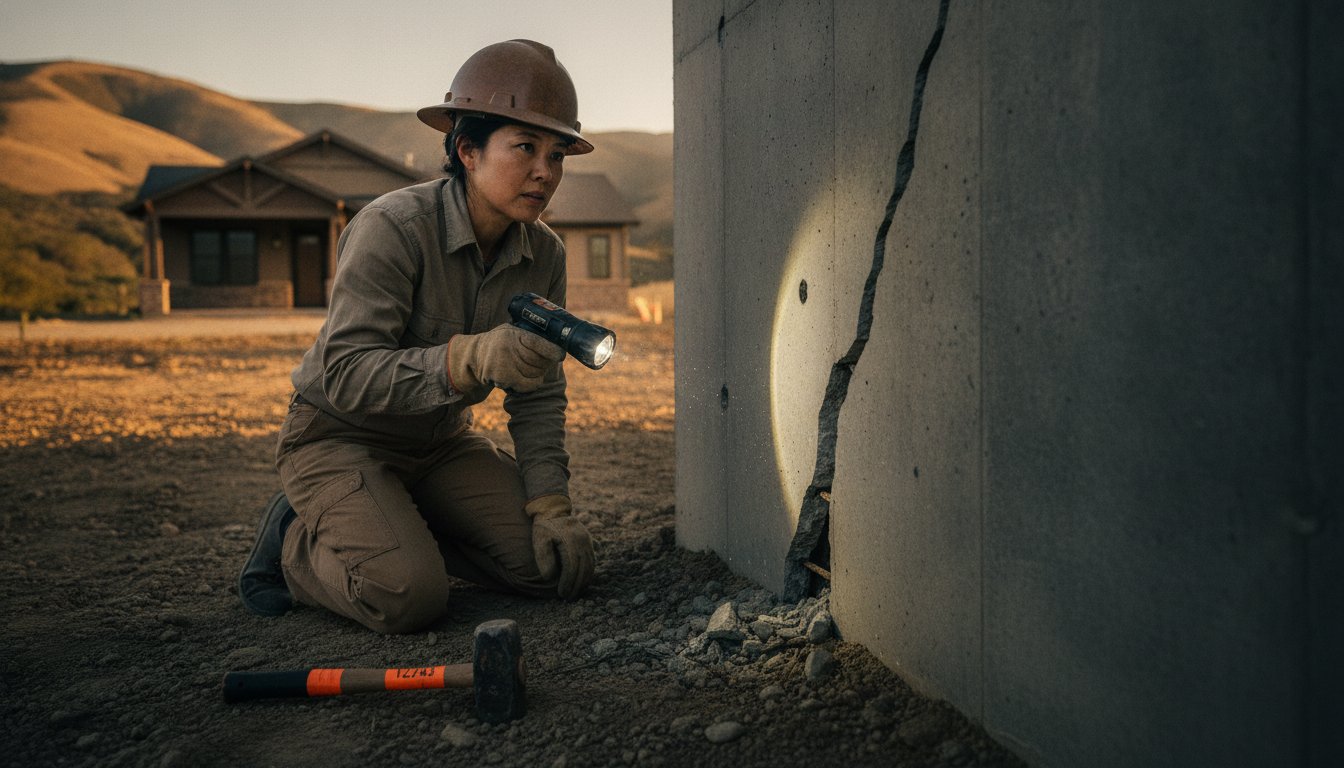
Foundation Cracks: When to Worry and How to Act (2026)
What if that thin line running across your concrete isn't just a sign of age, but your home's way of communicating structural stress? It's natural to feel a sense of dread when you spot new foundation cracks. You likely worry about escalating costs, the technical jargon used by contractors, and how your property will hold up against California's seismic activity. We understand that your home is your most significant investment. Its stability should never be a source of constant anxiety.
This guide provides the expert clarity you need to accurately identify, categorize, and address these issues to ensure long-term structural integrity. You will learn to distinguish between minor settling and serious failure. We also explain how the 2026 California Building Standards Code and the ASCE 7-22 seismic standards affect your stabilization options. By the end, you'll have a methodical plan of action and the peace of mind that comes from knowing your home's bones are secure. We focus on practical solutions and engineering-first responses to keep your foundation solid for decades to come.
Key Takeaways
- Distinguish between cosmetic hairline fractures and serious structural threats to prioritize home repairs effectively.
- Use a methodical inspection checklist to document findings and communicate clearly with structural contractors.
- Understand how the Bay Area’s unique wet-dry soil cycles and 2026 seismic standards impact your property's stability.
- Learn why professional foundation stabilization is essential for long-term integrity, rather than relying on temporary cosmetic patches for foundation cracks.
- Discover how a professional assessment prevents costly DIY mistakes and ensures your home meets updated California building codes.
Understanding Foundation Cracks: Normal Settling vs. Structural Threats
A home's foundation is its most critical system. We often call it the "bones" of the house. If the bones are weak, every high-end kitchen remodel or bathroom upgrade is at risk. From a Master Craftsman's perspective, structural integrity isn't just a requirement; it's a commitment to longevity and safety. You shouldn't settle for cosmetic fixes when the core of your property is speaking to you through foundation cracks.
Concrete is a durable material, but it's also prone to shrinkage. During the first 24 months after a pour, concrete undergoes a process called curing. As moisture evaporates, the material slightly contracts. This often results in minor, non-structural fissures. However, not all gaps are benign. A structural crack is any breach that compromises the load-bearing capacity of the footing or stem wall.
The Anatomy of a Hairline Crack
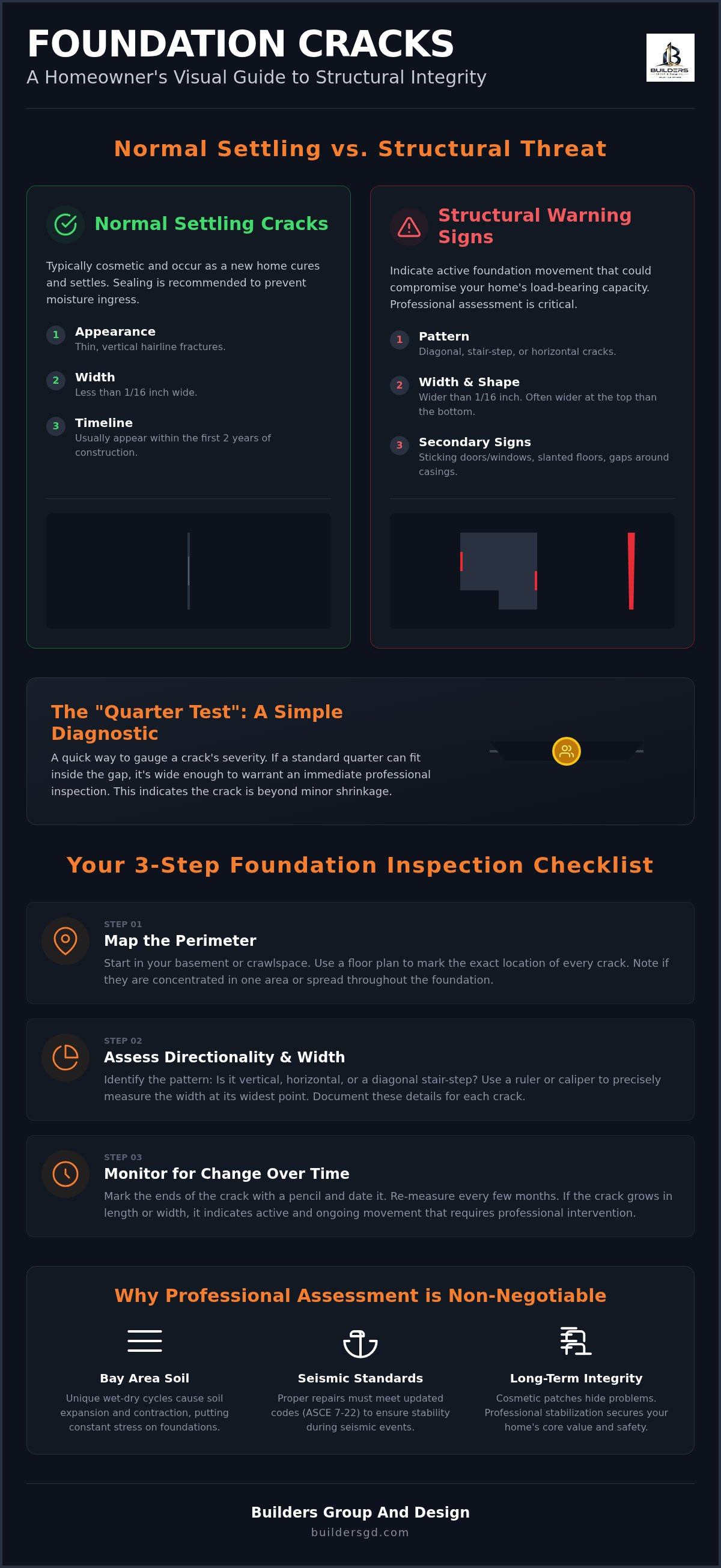
Micro-cracks are common in new construction. These typically appear within the first two years as the structure finds its footing in the soil. You can usually identify these by their size. If the gap is less than 1/16 of an inch wide and runs vertically, it's likely a standard shrinkage crack. While these don't threaten the home's stability, you shouldn't ignore them. Sealing these small openings prevents moisture from reaching the rebar inside the concrete. Keeping water out is the best way to prevent future corrosion and spalling.
Warning Signs of Active Movement
Active movement requires a different level of attention. You can perform a simple "Quarter Test" at home. If you can fit a coin into the crack, it's time to call a professional. Look for specific patterns that suggest shearing or shifting. For instance, Echelon cracks often indicate that the soil beneath your home is moving in different directions. This creates a diagonal stair-step pattern in brick or concrete blocks.
Pay attention to the shape of the gap. Cracks that are wider at the top than the bottom are a red flag for differential settlement. This means one part of your foundation is sinking faster than the rest. You'll likely notice secondary symptoms throughout the house. Doors might stick in their frames. Floors might start to feel slanted. Gaps may appear around window casings. These aren't just cosmetic annoyances. They're clear indicators that your foundation cracks have transitioned from a surface issue to a structural threat that demands stabilization.
The Homeowner’s Foundation Inspection Checklist
A methodical inspection is the first step toward peace of mind. It removes the guesswork from home maintenance. We follow a "measure twice, cut once" philosophy in every project we touch. This same logic applies to your home assessment. By documenting foundation cracks with precision, you provide a clear roadmap for any necessary repairs. This process reduces anxiety and ensures you aren't paying for cosmetic fixes when structural stabilization is required.
Step 1: Map the Perimeter
Start your inspection at the lowest point of the home. This usually means entering the crawl space or basement. Look for horizontal lines along the soil grade where the foundation meets the earth. Carry a simple floor plan or a notebook to document your findings. Mark the exact location of every fissure you find. Identifying where the stress is concentrated helps determine if the issue is localized or systemic.
Step 2: Assess Directionality and Width
Not all gaps are created equal. Identify the pattern of each opening. Vertical cracks often relate to settling, while diagonal or stair-step patterns in masonry can signal more complex soil movement. Use a digital caliper or a standard ruler to measure the widest point of the gap. Pay close attention to load-bearing corners. If a crack crosses through a corner where two walls meet, it often indicates a loss of support in the footing. For complex layouts, a professional structural assessment can clarify these technical findings.
Step 3: Monitor for Change Over Time
Foundations are rarely static. They respond to environmental stressors like heavy rain or local seismic events. You can use a dedicated "crack monitor" tool or simple pencil marks to track growth. Mark the date and width at the crack's terminus to track active expansion. If you notice the line creeping further or widening over a few months, the movement is active. This data is invaluable for a contractor. It helps us differentiate between a house that has finished settling and one that requires immediate foundation cracks intervention to prevent further failure.
Why Foundation Cracks Occur: Bay Area Soil and Environmental Stressors
The Bay Area presents a unique set of challenges for any structure. Over 60% of homes in this region are built on expansive clay soil. This material acts like a giant sponge. During our wet winters, the clay absorbs water and expands. In the dry summers, it shrinks and pulls away from the concrete. This constant cycle of movement puts immense stress on the "bones" of your property, often manifesting as foundation cracks. Understanding this environmental context is essential for any homeowner in Palo Alto or Walnut Creek.
Expansive Clay Soils in Palo Alto and Walnut Creek
In areas like Palo Alto, the soil's high clay content leads to seasonal "breathing." When the soil shrinks during a drought, the foundation loses its uniform support. This causes the house to settle unevenly. Repeated cycles of contraction and expansion can weaken the footings over time. While some minor movement is expected in older homes, persistent shifts can lead to significant structural failure. We see this often in Walnut Creek, where the soil profile is particularly reactive to moisture changes. It's a steady process of wear that requires a professional eye to monitor correctly.
Drainage and Hydrostatic Pressure
Surface water management is your first line of defense. In San Mateo, clogged gutters or poorly aimed downspouts frequently lead to foundation failure. When water pools against the stem wall, it creates hydrostatic pressure. This force pushes against the concrete, eventually causing foundation cracks. Proper hardscaping and grading are vital. You want to direct water at least five to ten feet away from the perimeter. Weakened soil from pooling water loses its load-bearing capacity, which allows the foundation to sink into the mud. We prioritize these "exterior bones" to ensure your home stays level.
Beyond soil movement, we must consider the seismic reality of Northern California. The USGS estimates a 33% probability of a major event on the Hayward Fault within the next 30 years. For residents in San Francisco and Oakland, soil liquefaction is a genuine concern. Saturated soil can lose its strength during an earthquake, causing foundations to shift violently. Investing in an earthquake retrofit residential plan is a proactive way to stabilize your home. It’s about building resilience before the next big shift occurs. Keep in mind that standard insurance rarely covers liquefaction damage, making structural reinforcement your best protection.
Beyond the Surface: Structural Stabilization and Repair Methods
Addressing foundation cracks requires more than a bucket of sealant and a putty knife. A surface patch might stop a draft, but it does nothing to restore the home's load-bearing capacity. We view repair as a two-stage process: stopping the movement and then reinforcing the structure. True stabilization ensures that the "bones" of your home can support the weight of your family and any future renovations. Skipping this step before a major remodel is a recipe for expensive failure.
Stabilization vs. Cosmetic Sealing
Epoxy or polyurethane injections serve a specific purpose. They're excellent for non-structural moisture control in hairline fissures. If your inspection reveals a dormant crack that isn't widening, these injections create a watertight barrier. However, you shouldn't use them to "hide" an active structural fracture. Covering a moving crack with drywall or paint only masks the symptoms while the underlying failure worsens. This is particularly dangerous if you're planning an open-concept layout. The cost to knock through a wall can escalate quickly if the foundation isn't stable enough to support the new point loads required by a steel beam. We always ensure the base is solid before we touch the framing above.
Professional Underpinning and Piering
When soil settlement is severe, we turn to underpinning. This method uses push piers or helical piers to transfer the home's weight from unstable surface soil down to competent load-bearing strata or bedrock. It's a "measure twice" operation that requires precision engineering. We use hydraulic equipment to drive steel piers deep into the earth. This process allows us to stabilize and, in many cases, lift the sunken portion of the foundation back toward its original level. You should expect a few days of noise and heavy machinery, but the result is a permanent solution for a shifting home.
Sometimes the issue isn't the perimeter wall, but the supports beneath your feet. A comprehensive crawl space structural repair often addresses the root cause of interior wall cracking. By reinforcing sagging joists or failing pier pads, we remove the stress that causes foundation cracks to telegraph through your finishes. This holistic approach protects your investment from the ground up. If you're concerned about the depth of your structural issues, contact us for a foundation stabilization assessment to get a straight-shooter's perspective on your home's health.
Protecting Your Investment: Professional Assessment and Long-Term Security
Attempting to fix foundation cracks with a bag of cement from a big-box store is a gamble most homeowners shouldn't take. While crowdsourced advice might suggest a quick DIY patch, these surface-level fixes lack the safety assurance and liability protection of a licensed professional. In a high-stakes market like the Bay Area, a failed repair is often more expensive than doing the job right the first time. We believe in transparency. A Straight Shooter contractor provides clear expectations and itemized plans, ensuring you aren't paying for marketing hype or temporary band-aids.
What a Structural Consultation Includes
A proper structural consultation is a data-driven process. We use laser leveling and floor elevation mapping to identify exactly where the structure has shifted. We also evaluate soil moisture and drainage patterns to address the environmental stressors that cause movement. This comprehensive approach ensures that every permit pulled in 2026 complies with the updated California Building Standards Code and the ASCE 7-22 seismic requirements. You receive a clear, itemized plan for stabilization that focuses on the physical reality of your home's needs.
The Builders Group Approach to Structural Integrity
Structural stability is a major selling point in competitive markets like Burlingame and Palo Alto. Savvy buyers and home inspectors look past the fresh paint to see if the bones are straight. A home with a certified, stabilized foundation commands a higher resale value because it represents a secure, long-term investment. It provides the buyer with the same peace of mind that you deserve today. We prioritize the bones of the home before the beauty of any remodel. We understand that your dream kitchen or residential addition is only as good as the foundation supporting it.
Our expertise as a construction framing contractor allows us to see how every component of the skeleton fits together. Whether we are reinforcing load-bearing walls or stabilizing a perimeter footing, our focus remains on precision and longevity. Serving the Bay Area from San Francisco to Lafayette, we bring a Master Craftsman's eye to every structural challenge. We don't just hide foundation cracks; we secure your home's future. Contact us for a professional assessment that puts structural integrity and your family's safety first.
Securing Your Home’s Foundation for the Long Term
Your home is your most significant investment, and its longevity depends entirely on the stability of its base. We have discussed how to distinguish between minor curing fissures and active structural threats that compromise your property's safety. By using a methodical inspection process and understanding the specific challenges of Bay Area soils, you can make informed decisions about your home's health. Addressing foundation cracks through professional stabilization is the only way to ensure your structure remains level and secure for decades to come.
Prioritizing structural integrity before starting a high-end remodel is the mark of a responsible homeowner. We bring Master Craftsman quality to every project, providing expert foundation stabilization for residents from Palo Alto to Walnut Creek. Don't leave your home's safety to chance or temporary cosmetic fixes. Secure Your Home’s Future: Schedule a Structural Assessment with Builders Group And Design. Taking a proactive step today ensures that your home’s bones remain strong enough to support your family’s future.
Frequently Asked Questions
Is a horizontal crack in a foundation serious?
Horizontal cracks are almost always a sign of serious structural distress. They typically occur when the soil outside the home exerts excessive hydrostatic pressure against the stem wall. This force causes the concrete to bow inward and fracture. Unlike vertical shrinkage lines, horizontal breaks suggest that the wall's load-bearing capacity is failing. You should seek a professional evaluation immediately to prevent a total wall collapse.
Can I fix foundation cracks myself with store-bought kits?
You can use store-bought epoxy or polyurethane kits for minor, non-structural moisture control. These are effective for sealing thin, dormant fissures to prevent water seepage. However, these kits cannot restore the structural integrity of a failing footing. If the foundation cracks are wider than a sixteenth of an inch or show signs of active movement, a surface-level patch will eventually fail. Structural stabilization requires specialized equipment and engineering.
How do I know if a crack is caused by an earthquake or settling?
Earthquake-induced damage usually appears suddenly as jagged, sharp-edged fractures following a seismic event. These cracks often run diagonally through corners or window frames. In contrast, settling is a gradual process that develops over months or years due to soil fluctuations. While both require attention, seismic damage often involves a wider range of structural components beyond the concrete itself. A detailed laser level survey can differentiate between these two types of movement.
Will foundation cracks affect my ability to sell my home in the Bay Area?
Unaddressed foundation cracks will significantly complicate a home sale in the Bay Area. California law requires homeowners to disclose known structural defects during the escrow process. Most buyers will insist on a structural inspection, and lenders may refuse to fund a loan if the foundation is compromised. Repairing the issues before listing your home often yields a better return than offering a price credit to a wary buyer.
What happens if I ignore a stair-step crack in my brickwork?
Ignoring a stair-step crack allows the underlying soil settlement to progress unchecked. These patterns indicate that one section of your home is sinking faster than the adjacent areas. Over time, the gap will widen, leading to significant water intrusion and pest infestations. Eventually, the uneven stress will cause internal framing to twist, resulting in jammed doors and cracked drywall throughout the living space. Early intervention is always the more affordable path.
Does insurance typically cover foundation crack repairs?
Standard homeowners insurance policies rarely cover repairs for foundation cracks caused by earth movement, settling, or hydrostatic pressure. These are typically viewed as maintenance issues or "acts of God" excluded from basic coverage. You generally need a separate earthquake policy or a specific endorsement for soil liquefaction to receive financial assistance for these repairs. Always review your policy's "earth movement" exclusions with your agent to understand your specific risks.
How long does a professional foundation stabilization take?
A professional stabilization project typically takes between three to ten business days to complete. The duration depends on the number of piers required and the accessibility of the site. Simple residential jobs involving a few push piers move quickly, while complex commercial additions or deep helical piering may take longer. We prioritize efficiency to minimize the disruption to your daily routine while ensuring every component is installed to Master Craftsman standards.
Can landscaping really prevent future foundation cracks?
Strategic landscaping is a highly effective way to manage the soil moisture levels around your home. Planting large trees too close to the perimeter can suck moisture out of the clay, causing the soil to shrink and the foundation to drop. Conversely, maintaining a consistent watering schedule and ensuring proper grading prevents the "sponge effect" of expansive soils. Well-planned hardscaping acts as a shield that keeps the ground beneath your home stable and dry.